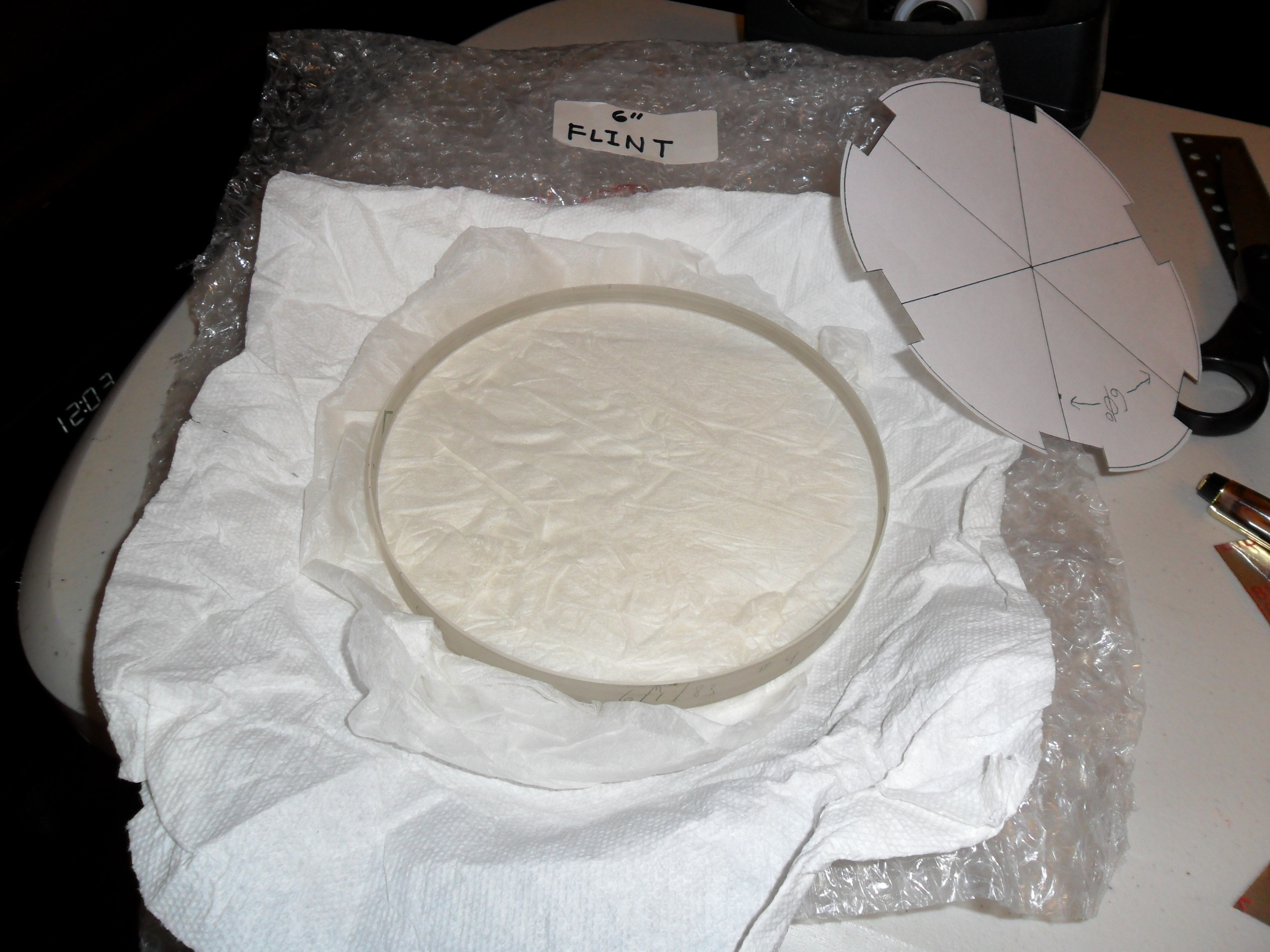
The unwrapped flint element sits on a bed of lens paper ready to
receive the aluminum spacer tabs that will be used to form an air
space gap between it and the crown element. Even though the flint
element is a softer glass than the crown, I still decided to install
the spacers on the flint. Some ATM'ers install the spacer tabs on the
back side of the crown to assure that the lens elements will always be
replaced in the correct orientation after cleaning. But, I chose to
install them on the front edge of the flint, because if I had to
rotate the crown element while it was still in the cell, the tabs
would rub against the harder crown, instead of the softer flint. It is
not often that I would have to rotate the elements, but on initial
mounting of the lens elements into the front lens cell of my
refractors, I generally like to train the telescope on a bright star,
then rotate the crown element to find the optimum performance position
in relation to the flint. On the other hand, doing this with the tabs
affixed to the back of the crown element could potential cause sleeks
or damage on the flint when the tabs rub against it during rotation.
Special Note --- Yes, it is true that
the crown element for a fraunhofer doublet has a front and a back
side, despite the fact that both sides of the lens element are convex.
BUT!... The difference is that one side has a deeper convex curve than
the other, which constitutes the back side that faces the front
concave side of the flint element. |
|